Two Great Books
There’s a lot of talk about China overtaking America as the largest economy in the world. Predictions differ on when this will happen, but everybody seems convinced it will. While I was in Thailand it was announced that China overtook Japan to officially become the second largest economy.
But there’s a lot of guesswork in that projection. It assumes that China can create jobs at the same pace, that no domestic problems arise in a very multi-cultural country, and that America doesn’t do much to compete. Rather than saying that China “will” overtake America, it seems wiser to say that China “can” do it if the past is any indication of future performance. But that’s by no means a sure thing.
I read two books flying to and from Thailand that address this issue (among others) in a well balanced and thoughtful way. They were encouraging, challenging, and academic.
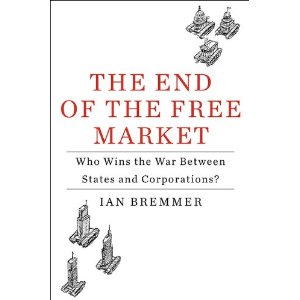
The first book is Ian Bremmer’s The End of the Free Market. Have you ever heard of “state capitalism”? Not many people have, but it’s one of the biggest challenges the American economy is going to face this century.
Essentially, state capitalism is a government (or quasi-government agency) making the macro level decisions about how to invest resources. It’s not communism or socialism; it’s state capitalism. Sometimes this is done to diversify a countries holdings so they are less reliant on a single source of wealth (think Saudi Arabia buying financial firms as a way to hedge against their vast oil position). But sometimes it is done to further national interests … and that’s where it gets a bit frightening.
Dozens of countries practice state capitalism, with China being the obvious poster child. The economic meltdown of 2008 has led some nations to perceive the China model as preferable to the American model. State capitalism is direct competition for large corporations because a government can subsidize losses to achieve political ends. It could put American corporations at a distinct disadvantage. Thus the threat to our economy.
Bremmer concludes with a modestly upbeat assessment of the future of capitalism, predicting that state capitalism will eventually fail the same way that mercantilism failed. He has done a good job of comprehensively laying this out in the book. This is not an easy read, but it is an important one.
The next book is The Future of Power by Joseph Nye. The book focuses on how nations can exert influence. The two simplistic methods are hard power (mostly military strength) and soft power (cultural appeal, foreign aid, persuasion, etc.). Nye argues that both are important and that the proper balance between the two is what he calls “smart power.”
Nye focuses on rising nations that may not always see eye-to-eye with America. Again, China is the obvious poster child. His conclusions strike me as accurate and remarkably well said. He has an upbeat view of America’s future in the 21st Century.
Reading the two books in succession was a great “macro” look at world economic and political structures. Ultimately, I found them both to be encouraging and pragmatic.